

Building Resiliency in Your Organization
Resiliency. In a rapidly changing world, the ability to detect and respond to disruption is no longer optional – it is critical to organizational performance and longevity. Business leaders today may face any number of challenges: technology advancements, economic downturns, environmental changes, and government regulation and policy changes are just a few examples. The key to adapting in the world we find ourselves in is by building resilience. How do we adapt? How do we “bounce back?”
In disaster-recovery circles, resilience is often illustrated using the Resilience Triangle, which depicts organizational performance over time (Zobel, 20101). When a disruption occurs, performance drops below normal levels and gradually recovers; the resulting “triangle” represents the total impact of the disruption. Resilience is measured by how deep the drop is, how long recovery takes, and how fully performance is restored. Highly resilient organizations experience smaller declines and recover more quickly, minimizing the overall area of the triangle. In this way, resilience is not about avoiding disruption altogether, but about absorbing shock, adapting rapidly, and restoring operational capacity with minimal loss.
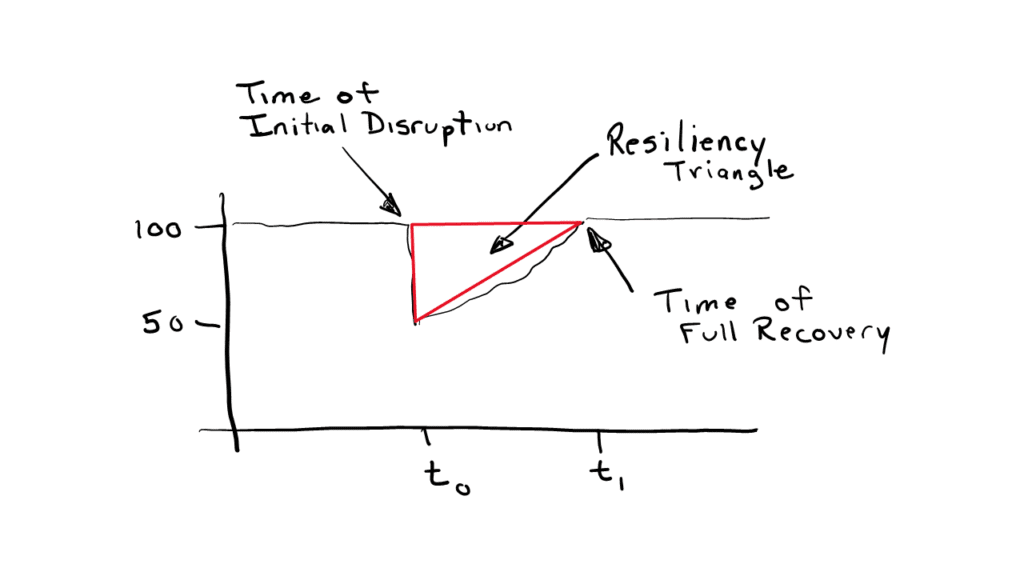
Adopting self-management can be a powerful way to improve resilience. Self-management removes layers, improves trust, and empowers your team to take ownership of decision-making. Moving layers of bureaucracy out of the way leaves room for quick decisions and faster response.
Let’s take a look at how self-management can improve the resilience of your organization.
- Recognize threats sooner. When everyone in the organization is empowered to observe, interpret, and act on emerging signals, disruptions can be identified earlier—often before they escalate into full-scale crises. This distributed awareness functions like an early-warning system, reducing the depth of performance decline and allowing the organization to begin adapting sooner. —ultimately shrinking the resilience triangle by limiting both the severity and duration of disruption.
- Empower faster decision making. In a traditional organization, employees await direction or must go up the chain to ask permission. In a self-managed organization, employees are trusted with authority to pivot when necessary and leverage their knowledge and experience to make decisions within pre-set guardrails. This structure saves critical time when responding to new conditions or threats.
- Fostering innovation and problem-solving. Self-managed organizations create environments where experimentation is expected and learning is continuous. Rather than waiting for solutions to be developed at the top, individuals and teams are empowered to test ideas, adapt processes, and respond creatively to emerging challenges. As a result, the organization can stabilize and recover from disruption more quickly, shortening the recovery phase.
- Enhancing employee engagement. By giving employees agency over their tasks, schedules, and development, they themselves become resilient. Deeper engagement increases attentiveness, motivation, and persistence – especially during periods of disruption. Rather than disengaging or waiting passively for direction, engaged employees lean in, adapt, and help carry the organization forward.
- Promoting collaboration and communication. Hierarchical organizations typically create stovepipes of information. Self-management breaks down the walls of a hierarchy, creating collective intelligence, shared information, and the ability to quickly stand up -and then stand down – groups to solve specific issues. By improving coordination and reducing bottlenecks, organizations respond more effectively and restore performance more quickly, minimizing the overall impact of disruption.
Self-management does not eliminate disruption, but it fundamentally changes how an organization experiences and responds to it. By empowering people closest to the work to see clearly, decide quickly, and act collaboratively, organizations can reduce the depth and duration of disruption and restore performance with greater speed and strength.
Want to learn more? Contact us.
- Zobel, C. W. (2010). Comparative visualization of predicted disaster resilience. ISCRAM, ↩︎
